
DEMOCRATIA AQUA TECHNICA VII
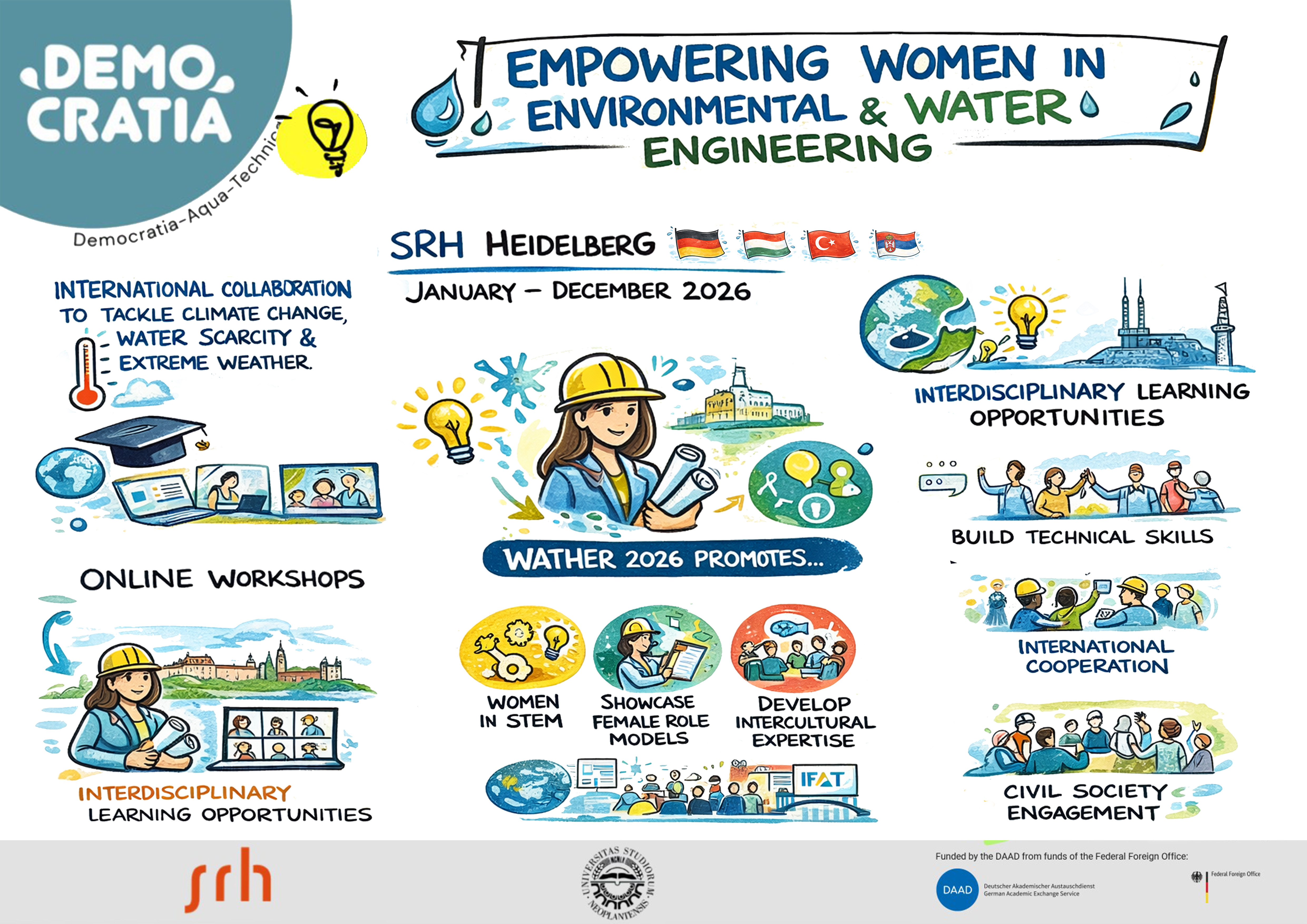
Project Overview:
WatHer
Empowering Women in Environmental Engineering
Project: Democratia – Aqua – Technica VII: WatHer
Focus: Women in Environmental & Water Engineering
Duration: January–December 2026
Lead institution: SRH University of Applied Sciences Heidelberg
Partners: Universities in Serbia, Türkiye, and Hungary
Project Description :
Democratia – Aqua – Technica VII, also known as WatHer, is an innovative international project led by the SRH University of Applied Sciences Heidelberg in collaboration with partner universities in Serbia, Türkiye, and Hungary. Running from January to December 2026, the project addresses the growing challenges of climate change, water scarcity, and extreme weather events, while promoting gender equity in engineering.
WatHer is designed to empower women in environmental and water engineering by providing students with hands-on, interdisciplinary learning opportunities. Through a combination of online workshops, a ten-day Spring School in Heidelberg, participation in the IFAT international water technology fair in Munich, and a culminating online conference, students develop both technical expertise and intercultural skills. The project emphasizes collaboration across borders, disciplines, and genders, ensuring that diverse perspectives are integrated into solutions for complex water conflicts.
By fostering international cooperation and highlighting female engineers as role models, WatHer strengthens the visibility and influence of women in traditionally male-dominated STEM fields. The initiative builds on the established Democratia – Aqua – Technica network, leveraging years of experience in education, research, and civil society engagement.
WatHer seeks to:
-
Empower women in engineering: Mentorship, role models, and practical experience.
-
Foster international collaboration: Universities, industry partners, and civil society.
-
Promote gender-sensitive solutions: Addressing water conflicts in partner countries.
-
Build long-term impact: Strengthen female participation and diversity in STEM fields.
Activities
The WatHer program combines online and in-person learning, ensuring participants gain both theoretical knowledge and practical experience. Key activities include:
-
Online Kick-Off Event: Introducing students to the project, building diverse teams, and exploring the intersection of water conflicts, technology, and gender.
- Spring School in Heidelberg: Intensive workshops, expert lectures, field visits, and the IFAT fair experience provide hands-on learning and networking opportunities.
-
Online Tutorings: Continuous support for student groups working on case studies, integrating gender perspectives and technical expertise.
-
Final Online Conference: Presentation of student projects, discussion with international experts, and dissemination of research outcomes to the public
Outcomes & Impact
WatHer aims to deliver measurable outcomes for participants, institutions, and society at large. Students gain technical knowledge, cross-cultural competencies, and professional networks, positioning them as future leaders in water and environmental engineering. The project enhances visibility of women in STEM, inspires civil engagement, and strengthens international academic partnerships. Outputs, including student projects, conference proceedings, and practical case studies, will be publicly available through the Democratia network website.
Alignment with SDGs
The project supports the following United Nations Sustainable Development Goals:
-
SDG 4: Quality Education
-
SDG 5: Gender Equality
-
SDG 6: Clean Water and Sanitation
-
SDG 17: Partnerships for the Goals
By embedding these objectives into the project framework, WatHer ensures both academic excellence and societal impact.
Project Team & Contacts
The project is led by Prof. Dr. Ulrike Gayh (SRH University of Applied Sciences Heidelberg) and implemented with a highly qualified international team.
-
Prof. Dr. Maja Turk-Seculić – University of Novi Sad
-
Prof. Dr. Yasemin Dilşad Yılmazel – Middle East Technical University
-
Prof. Dr. Neşe Yaman – Dicle University
-
Katalin Dudás Kószó – University of Pécs
The team is responsible for academic guidance, mentoring, and project coordination, ensuring high-quality implementation and the professional development of all participants.
Call for Participation
WatHer is open to Master’s students in environmental and water engineering from the partner universities. Applicants are selected based on academic excellence, motivation, and English proficiency. The program emphasizes gender balance, aiming for at least 50% female participation, and offers scholarships covering travel, accommodation, and participation costs. Interested students can apply via the Democratia Website
Sustainability & Diversity
The project is designed to minimize environmental impact through digital collaboration, climate-friendly travel, and sustainable resource use during in-person events. Gender equality, intercultural understanding, and inclusion are central to the project’s philosophy, ensuring lasting benefits beyond the 2026 project cycle. By promoting female leadership in engineering, WatHer contributes to structural change in STEM education and professional pathways.